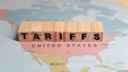
The US has implemented its new 10% tariff and is seeking a more secure legal framework to facilitate a 15% rate.
Elsewhere, the UK is talking tech with the US, seeking critical minerals from Kazakhstan and continuing to pursue entrance to the EU’s new ‘Made in Europe’ scheme.
‘Our goal… is continuity’
US trade representative Jamieson Greer has said the Trump administration is searching for a more permanent legal mechanism by which to implement tariffs of both 10% and 15% in order “to have continuity”.
Following the Supreme Court’s 6-3 ruling against the legality of much of Trump’s reciprocal tariff regime last week, the US president used a different law to introduce a 10% global tariff rate on all imports to the US, having also stated he wanted to increase this to 15%. Under Section 122 of the 1974 Trade Act used by the administration, the 10% tariff rate can be in place for 150 days.
In the meantime, Greer confirmed in an interview with Bloomberg Television:
“Our goal with all of this is to have continuity.
“So we want to have the 10%... and we’re looking about how to implement the 15% that the president indicated because we want to have continuity.”
He added that he wants “countries”, “companies” and “people” to understand that the administration will “keep going” with its planned trade policy.
“What we were doing before,” he said, “we’re going to reconstruct with alternative tools.”
His comments suggest that opposition from countries like the UK and Australia, which secured 10% tariff rates in deals struck last year, was successful and these deals could be honoured.
US-UK tech talks
Despite Greer’s talk upping the ante on tariffs, there were signs of deeper cooperation between the US and the UK, which restarted talks on a tech deal yesterday (25 February).
The FT reports that senior US and UK officials have discussed collaboration on nuclear energy and a potential summit on fusion technology.
Last year, UK prime minister Sir Keir Starmer said the deal marked a dawning “golden age” of nuclear energy, enabling quicker approval for the construction of nuclear power plants in both countries.
However, talks towards a ‘Tech Prosperity Deal’ were suspended last year, stalling a projected £31bn of investment from top US tech companies, according to the UK government.
Negotiations were paused in December as the Trump administration pushed for wider concessions on trade in sensitive areas, including UK food standards to facilitate greater US agricultural exports and the UK’s Digital Services Tax on US tech companies.
Other areas of scientific cooperation touted last year, including AI and quantum computing have not progressed, with Greer and Starmer’s special envoy to the US on trade and investment, Varun Chandra, agreeing to a more limited focus on nuclear energy last month at the World Economic Forum.
UK tells EU to stop ‘putting up barriers’
As he seeks to negotiate the UK’s inclusion in the EU’s ‘Made in Europe’ trade programme, UK business and trade secretary Peter Kyle called on Brussels to stop “putting up barriers” between itself and aligned countries.
“We have to get to a point amongst western allied countries where we’re not putting up barriers to societal and economic development amongst ourselves”, he told journalists yesterday.
Describing threats to economic security and independence, including Chinese dominance in a number of critical areas, he said that the UK and EU shared many of the same challenges and should be working together to overcome them.
Kyle travelled to Brussels yesterday to discuss participation in the EU’s industrial scheme, following remarks from French officials that the UK couldn’t expect to “have the cake and eat it too".
UK critical minerals deal
The UK is moving ahead with plans to diversify its critical mineral supplies from China, striking a deal with Kazakhstan.
The central Asian nation produces 22 of the 36 minerals identified by the British government in its Critical Mineral Strategy, published last year.
Foreign secretary Yvette Cooper told Politico that the region has “huge potential to boost economic growth”.
“These agreements deliver for British businesses, strengthen economic security and are a clear demonstration of UK support for the independence of the Central Asian states.”
The deal includes education provisions that Cooper says will promote independence in the region, a Coventry University campus in Almaty, Kazakhstan, and an AI centre at capital Astana’s Cardiff University campus.
A new agreement on cooperation with Uzbekistan, Tajikistan and Turkmenistan is also set to be announced. Foreign ministers from those four nations, plus Kyrgyzstan, will be hosted by Cooper at Lancaster House today (26 February).
Merz on Chinese trade imbalance
German chancellor Friedrich Merz called for a reset of China-Germany trade relations to address German’s growing trade deficit with the superpower, which reached €90bn in 2025.
Merz has been under pressure from German industry to take a firmer stance on China, which many regard as responsible for rapid losses of manufacturing jobs. Figures released last year showed the economy was down almost 250,000 jobs since the beginning of the Covid-19 pandemic.
Striking a more diplomatic note, Merz told reporters after meeting Chinese Premier Xi Jinping:
“We want to reduce these imbalances, which have arisen primarily from overcapacity in China.”
He added that “competition between companies must be fair”, saying that “we need transparency, we need reliability, and we also need compliance with jointly established rules”.
China’s Ministry of Foreign Affairs released a statement after the meeting saying that both countries should “champion openness and win-win results”. Describing China and Germany as “the world’s second and third largest economies”, respectively, it expressed hope that China can “share development opportunities with Germany and the wider world”.
“We hope the German side can view China’s growth in an objective and rational manner, pursue a positive and pragmatic policy toward China, and work with China for steady and sustained growth of the bilateral relationship.”
It also noted alignment between Germany’s goals in “technology, innovation and digital development” and China’s “objective of pursuing intelligent, green and integrated development”, as set out in its 15th five-year plan. Notably, green manufacturing is a significant site of Chinese export capacity in Europe.
Elsewhere in the headlines
· To honour an election pledge not to import ‘cruel’ foods, the Labour government is seeking a carve out in any EU deal to ban imports of foie gras, the inews reports
· A draft text for an EU-UK agreement regarding Gibraltar has been published today. As checks between Gibraltar and Spain’s land border have been removed, full EU import compliance will be required for UK firms completing UK-Gibraltar-EU movements
Yesterday in trade
· EU institutions embarked on discussions to reduce the quotas set out for tariff-free steel imports, a move that could rock UK exporters
· UK SMEs shared the impact of changes to Brussels’ de minimis relief for low value imports into the bloc
· New investment is set to spur the return of rail freight to the UK-EU cross-Channel Tunnel


