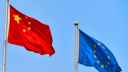
The EU continues to evaluate how it tackles the problem of Chinese industrial overcapacity, with a proposed regulation setting out caps on the proportion of manufacturing components European firms can buy from a single supplier.
Less ambiguous is the bloc’s stance on the UK rejoining as a member state, with officials close to Brexit warning that Brussels would be “welcoming” but “hard-headed” on re-entry terms.
Also in ‘The Day in Trade’ is the latest from the US on Russia and Iran sanctions.
EU’s latest measure to tackle Chinese imports
EU trade commissioner Maroš Šefčovič is spearheading a new regulation to limit the number of components European companies can buy from a single supplier.
Under new regulations a ceiling of between 30 and 40% would be introduced, forcing firms to buy components from at least three suppliers.
The FT reports that two EU officials have confirmed the rules are designed to reduce the EU’s dependence on Chinese imports, limiting cheap imports which are undermining Europe’s manufacturing sector.
“In many areas we are gradually becoming dependent on exports from China. Dependencies have a price and therefore we have to redouble our efforts [to diversify],” one senior official told the publication.
The proposal comes as other senior European trade officials warn that low-value Chinese imports of manufacturing components pose as big a threat to the EU’s industrial base as higher-value manufactured goods.
The president of the European Chamber of Commerce in Beijing, Jen Eskelund, said that “the problem” is not with Chinese electric vehicles or finished goods.
“It is the sheer volume of components being imported from China. If anything, Europe is getting more dependent on China.”
The head of foreign trade at VDMA, Germany’s trade association for mechanical and plant engineering companies, Oliver Richtberg, told the Guardian that German and European firms could not compete with China’s subsidised manufacturing sector.
He said European firms are making a “rational choice” when they buy Chinese products of a similar quality for a fraction of the price but warned “[the EU is] losing market share, our industry is under significant pressure”.
“We lost 22,000 jobs alone in Germany in the machinery industry in the last year.”
European commissioners are set to discuss the issue of Chinese industrial overcapacity at the end of the month (29 May).
UK faces ‘hard-headed’ EU terms to rejoin bloc
The brewing Labour leadership contest has put rejoining the EU firmly back on the political agenda, following Wes Streeting’s comments over the weekend.
Amid contenders positioning over whether they would or would not seek to rejoin the trade bloc, senior figures from Brussels have warned that the UK would not receive the same favourable terms as in 1973 when it joined the then European Economic Community.
Georg Riekeles, former adviser on the EU’s Brexit taskforce, told the Guardian that while the UK could expect a “warm, welcoming” stance from Brussels, it would also be a “hard-headed” one.
“I don’t think there would be an appetite for opening up new decades of British exceptionalism,” he said. “The price of re-entry would be membership on normal terms.”
It’s expected that the UK could be asked to adopt the Euro as its currency in order to rejoin, and would not receive the ‘financial rebate’ negotiated under prime minister Margaret Thatcher, which reduced the UK’s EU contribution to 66% of the standard rate paid by members.
US suspension of Russian oil sanctions extended…
The US has reversed its position on ending a suspension of Russian oil sanctions. Instead, US Treasury secretary Scott Bessent announced yesterday (18 May) that a 30-day general licence would be made available for purchases of Russian oil products already in transit.
According to Bessent, the waiver was reintroduced after the previous suspension lapsed on Saturday, following calls from “energy-vulnerable” countries unable to access Middle East oil exports amid the US/Israeli war in Iran.
“This extension will provide additional flexibility, and we will work with these nations to provide specific licences as needed," Bessent said.
"This general licence will help stabilise the physical crude market and ensure oil reaches the most energy-vulnerable countries.”
… as Iran sanctions called for
Today (19 May), Tehran shared the latest round of peace proposals with the US, which included the lifting of sanctions, the release of frozen funds and an end to US marine blockade of its ports – a retaliatory measure for Iran’s de facto closure of the Strait of Hormuz.
Reuters reports that terms differ little from the previous Iranian proposal which US President Donald Trump dismissed.
Earlier this week, US President Donald Trump issued further threats against Iran, claiming “there won’t be anything left of them” if Tehran doesn’t progress negotiations.
This follows Bessent’s calls last week for G7 countries to sanction Iran during a meeting of the group’s finance ministers in Paris.
“We call on all the G7 and on all of our allies and the rest of the world to follow the sanctions regimes so that we can crack down on the illicit financing that is fuelling the Iranian war machine and get this money back to the Iranian people.”
Elsewhere in the headlines
- Culture secretary Lisa Nandy is leading a delegation of over 250 business and culture leaders to a the Greater Together LA trade expo, with the aim of securing growth opportunities across areas including cultural exchange, scientific innovation, fintech, AI and quantum computing
- The IMF upgraded the UK’s growth prospects from 0.8% to 1% for 2026. That bright spot of economic news was undercut by a surprise jump in unemployment rates between February and March.
Yesterday in Trade
- The UK was reportedly close to clinching its trade deal with the Gulf Cooperation Council
- The government’s Nationalisation (Steel) Bill was set to be laid before Parliament this week
- Chancellor Rachel Reeves was reported to be readying plans to mitigate the impact of Iran war inflationary pressures
You can read those stories and more here.

 Member exclusive

